Álvaro Crosta
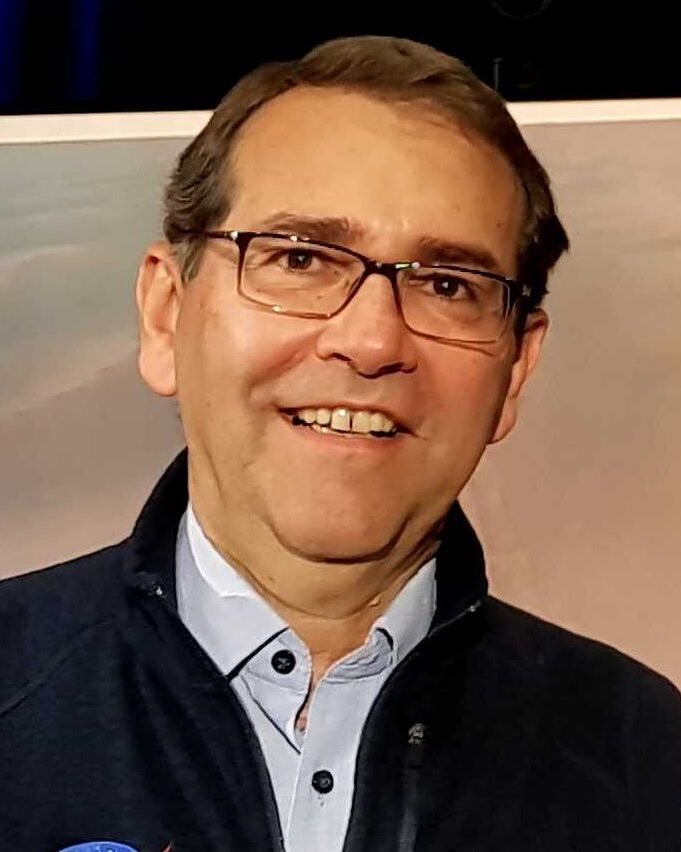
Alvaro Penteado Crósta is Professor Emeritus at the University of Campinas (UNICAMP) and Senior Full Professor at the Institute of Geosciences. He is a Full Member of the Brazilian Academy of Sciences and the São Paulo State Academy of Sciences and holds a Research Productivity Fellowship from CNPq. He served as General Coordinator (Vice-Dean) of UNICAMP from 2013 to 2017. He is a member of the CT-MINERAL Steering Committee (2026–2028), an elected member of the Meteoritical Society Council (2023–2026), a member of the Society of Economic Geologists (SEG) Nominating Committee (2023–2024), and a member of the Scientific and Cultural Council of the UNICAMP Institute of Advanced Studies (IdEA –...
Álvaro Crosta
Mini BioAlvaro Penteado Crósta is Professor Emeritus at the University of Campinas (UNICAMP) and Senior Full Professor at the Institute of Geosciences. He is a Full Member of the Brazilian Academy of Sciences and the São Paulo State Academy of Sciences and holds a Research Productivity Fellowship from CNPq. He served as General Coordinator (Vice-Dean) of UNICAMP from 2013 to 2017. He is a member of the CT-MINERAL Steering Committee (2026–2028), an elected member of the Meteoritical Society Council (2023–2026), a member of the Society of Economic Geologists (SEG) Nominating Committee (2023–2024), and a member of the Scientific and Cultural Council of the UNICAMP Institute of Advanced Studies (IdEA – 2022). He earned his degree in Geology from USP in 1977, completed his master's degree at the National Institute for Space Research (INPE) in 1982, and obtained his doctorate from Imperial College London in 1990. He held visiting researcher positions at the Desert Research Institute (University of Nevada, Reno) from 1995 to 1996; the University of Vienna (Austria) in 2011; Humboldt University (Berlin, Germany) in 2011; and the Jet Propulsion Laboratory (NASA/CalTech) in Pasadena, California, USA, from 2018 to 2019. At UNICAMP's Institute of Geosciences, he served as Department Head, Coordinator of the Graduate Program in Geosciences, Graduate Studies Coordinator, and Director. In UNICAMP's senior administration, he served as Deputy Chief of the Rector's Cabinet and Dean of University Development. His academic fields of expertise are Remote Sensing, Mineral Exploration, and Planetary Geology/Meteorite Craters. He is a member of the Geotechnologies Research Group at UNICAMP. He served on the CAPES Geosciences Area Committee from 2002 to 2013, acting as Deputy Coordinator (2008–2010) and Area Coordinator (2011–2013). He was a member of the Executive Committee for the IODP Brazil Program (International Ocean Discovery Program), appointed by the CAPES presidency (2015–2019). He has served on the CNPq Geosciences Advisory Committee (CA-GC) during the 2015–2018 and 2021–2024 terms. He was elected a Fellow of the Society of Economic Geologists (SEG) in 2010 and received the SEG Regional Vice President Lectureship award that same year. He also served on the SEG Distinguished Lecturer Committee (2011–2013) and was the SEG Regional Vice President for South America (2011–2013). He is currently an Associate Editor for Economic Geology (SEG) and the Brazilian Journal of Geology. He served as an Associate Editor for the Geological Society of America Bulletin (2010–2016) and was a member of the Meteoritical Society's Barringer Medal and Award Selection Committee (2012–2016). He represented Brazil (via CAPES) on the JOIDES Resolution Facility Board of the International Ocean Discovery Program (IODP) (2016–2017). He twice received the Zeferino Vaz Academic Recognition Award from UNICAMP (1994 and 2019). In 2010, he was honored with the Diploma of Merit by the Regional Council of Engineering, Architecture, and Agronomy of the State of São Paulo (CREA-SP). As an academic advisor, he received an Honorable Mention for the CAPES Award in the Geosciences field in 2008 and the CAPES Award in the same field in 2013. He was named an Honorary Citizen of two Brazilian cities—Coronel Vivida (PR) and Vargeão (SC)—in recognition of research conducted on meteorite impact craters located in those municipalities.
Earth's Other Story: Cosmic Catastrophes that Shaped our Planet
Despite current concerns regarding climate change and its impact on Earth and its life, one must remember that our planet has gone through countless catastrophic events throughout its 4.54 billion years of history. This talk explores some of these events, with particular emphasis on those triggered by extraterrestrial—or cosmic—phenomena. Earth's evolution, and that of the life it supports today, has been shaped by the interplay of endogenous and exogenous processes. These interactions continue to influence our planet and will remain fundamental drivers of its evolution for billions of years to come.