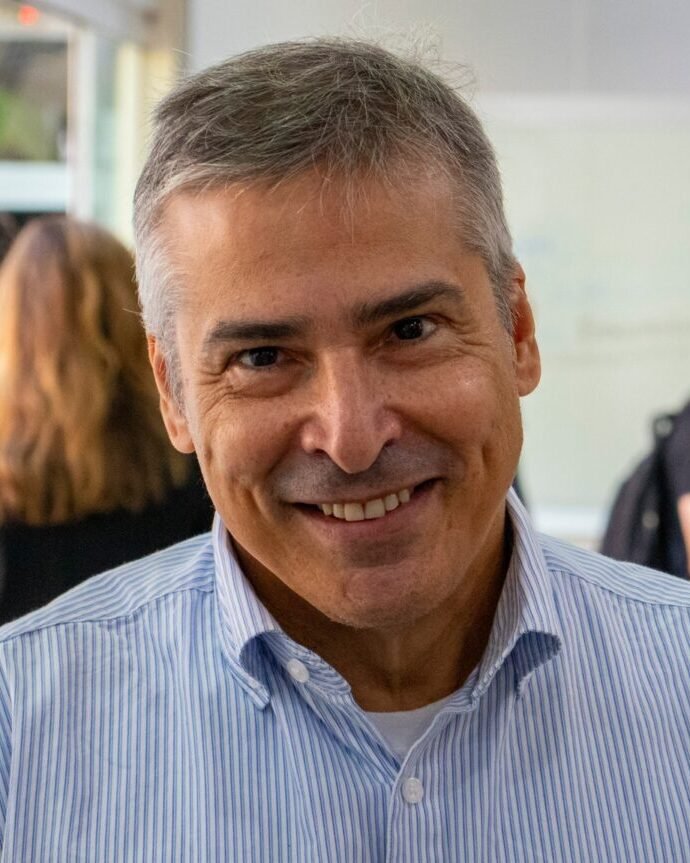
André C. Ponce de Leon F. de Carvalho
Professor André CP de Leon F Carvalho holds a PhD in Electronic Engineering from the University of Kent, England. He is a Full Professor and current Director of the Institute of Mathematical and Computer Sciences (ICMC) at the University of São Paulo (USP). He serves as the Coordinator of USP’s Office for Digital Transformation and Artificial Intelligence, Vice Coordinator of USP’s Center for Artificial Intelligence and Machine Learning (CIAAM), and is a Full Member of the Brazilian Academy of Sciences (ABC). He served two terms as Vice President of the Brazilian Computing Society (SBC). Since 1987, his research has focused on Artificial Intelligence, specifically Machine Learning and Data...
André C. Ponce de Leon F. de Carvalho
Mini BioProfessor André CP de Leon F Carvalho holds a PhD in Electronic Engineering from the University of Kent, England. He is a Full Professor and current Director of the Institute of Mathematical and Computer Sciences (ICMC) at the University of São Paulo (USP). He serves as the Coordinator of USP’s Office for Digital Transformation and Artificial Intelligence, Vice Coordinator of USP’s Center for Artificial Intelligence and Machine Learning (CIAAM), and is a Full Member of the Brazilian Academy of Sciences (ABC). He served two terms as Vice President of the Brazilian Computing Society (SBC). Since 1987, his research has focused on Artificial Intelligence, specifically Machine Learning and Data Science, with applications across various fields. He coordinates the IARA Applied Research Center in Artificial Intelligence (CPAIA) for Smart and Sustainable Cities, one of the 12 Brazilian AI Research Centers supported by the Ministry of Science and Technology, FAPESP, and CGI.br. Additionally, he coordinates the National Institute of Science and Technology (INCT) for AI for Social Good and the Embrapii Unit in Data Science, Computing, and Applied Mathematics at ICMC-USP. A three-time Jabuti Prize finalist (winning in 2012 for the book Artificial Intelligence: A Machine Learning Approach), he has supervised three CAPES award-winning doctoral theses (two for Best Thesis in Computer Science and one Honorable Mention) and four doctoral theses that were finalists in the SBC Thesis and Dissertation Competition (winning two for Best Thesis). In 2025, one of his supervised theses received the awards for Best Doctoral Thesis in Exact and Earth Sciences defended at USP, as well as the UNICAMP - Vladimir Herzog Institute 2025 Academic Recognition in Human Rights in the category of Doctoral Thesis in Exact Sciences, Engineering, and Technology. He served twice as a member of the CNPq Advisory Committee for Computer Science. He participates in several international committees, including the UK Expert Advisory Panel for the AI Safety Report, supported by the UN and OECD. He is the current coordinator of the Working Group on Machine Learning and Data Mining of the International Federation for Information Processing (IFIP).
Artificial Intelligence: When, What, How and Why
With all the attention it has received in recent years and its widespread use across several application domains, artificial intelligence is in its golden age. In this talk, after briefly presenting the origins of the field and introducing the main basic aspects of artificial intelligence, with a focus on machine learning, I will discuss how the area has evolved, its successes and pitfalls, where artificial intelligence has been successfully used, the international scenario, the situation of artificial intelligence in Brazil, and the main risks and opportunities. During the talk, I will briefly show some applications of artificial intelligence in different areas